BUDOPHILE//KB
HomeGuidesGlossaryFAQAbout
Search
HomeGuidesCan I Get Medical Cannabis on the NHS?
Can I Get Medical Cannabis on the NHS?

6 min readBeginner LevelUpdated 2026-06-27
ShareX
NHS medical cannabis prescription guide UK

The reality of NHS cannabis prescriptions in the UK — who qualifies, what conditions are covered, why over 99% of patients go private, and how to navigate the system in 2026.

This guide is for educational purposes only. Cannabis is illegal in the UK without a medical prescription. Always consult a healthcare professional before making decisions about cannabis use.

On 1 November 2018, the UK government rescheduled cannabis under the Misuse of Drugs Regulations 2001, moving Cannabis-Based Products for Medicinal use in humans (CBPMs) from Schedule 1 to Schedule 2. This legally permitted specialist doctors to prescribe cannabis. However, the reality of NHS prescribing has fallen far short of public expectation.
Since the legislation took effect, fewer than five patients across the entire United Kingdom have received ongoing NHS funding for unlicensed full-spectrum cannabis flower or whole-plant extracts. The vast majority of healthcare professionals working within the NHS remain bound by strict clinical commissioning guidelines that effectively block funding for whole-plant botanical cannabis.
The primary barrier is institutional: the National Institute for Health and Care Excellence (NICE) guideline NG144 stipulates that there is insufficient high-level Randomized Controlled Trial (RCT) evidence to support broad NHS funding for unlicensed cannabis-based products, particularly for chronic pain, generalized anxiety, and insomnia.
This institutional position creates a stark two-tier healthcare divide in the UK: patients who can afford private specialist consultations and monthly medication costs can legally access a wide range of CBPMs, while those reliant exclusively on NHS care are almost universally excluded.
The NHS will routinely fund only three specific, pharmaceutical-grade cannabinoid medications that have received formal marketing authorization (licenses) from the Medicines and Healthcare products Regulatory Agency (MHRA):
1. Epidyolex (cannabidiol): A highly purified (>98% pure), plant-derived CBD oral solution manufactured by GW Pharmaceuticals/Jazz Pharmaceuticals. It contains negligible THC (<0.1%). It is licensed strictly as an add-on therapy alongside clobazam for severe childhood-onset epilepsies — specifically Lennox-Gastaut syndrome, Dravet syndrome, and tuberous sclerosis complex (TSC). Prescriptions must be initiated by tertiary NHS paediatric neurologists.
2. Sativex (nabiximols): An oral mucosal spray containing a precise 1:1 ratio of THC (2.7mg per spray) and CBD (2.5mg per spray) extracted from cloned cannabis plants. Sativex is licensed exclusively for treating moderate-to-severe spasticity in adult Multiple Sclerosis (MS) patients who have failed to respond to first-line antispasmodics like baclofen or tizanidine. Even for MS, local Integrated Care Boards (ICBs) vary widely in their willingness to approve funding.
3. Nabilone (Cesamet): A synthetic cannabinoid analogue that chemically mimics delta-9-THC. It is licensed strictly for managing refractory chemotherapy-induced nausea and vomiting (CINV) in oncology patients who have not responded to standard antiemetics such as ondansetron or dexamethasone. It is almost exclusively dispensed in hospital oncology wards.
Crucially, no NHS trust or ICB routinely funds raw cannabis flos (flower for dry herb vaporization) or full-spectrum botanical extracts, despite these making up more than 90% of prescriptions in the private medical cannabis sector.
When an NHS specialist doctor believes an unlicensed cannabis product is necessary for a patient outside standard NICE criteria, they must submit an Individual Funding Request (IFR) to the patient's local Integrated Care Board (ICB).
An IFR requires the clinical team to prove 'exceptionality' — demonstrating not only that the patient has a severe, treatment-resistant condition, but that their clinical circumstances are significantly different from other patients with the same diagnosis, and that they will derive unique clinical benefit that justifies the public cost.
In practice, over 95% of cannabis-related IFR applications are rejected at the panel review stage. Commissioning panels frequently cite lack of cost-effectiveness, absence of phase-3 clinical trial data, and potential precedent-setting budget liabilities as reasons for refusal.
For families of children with severe, intractable epilepsies who do not respond to Epidyolex, navigating the IFR pathway has proven heartbreakingly difficult, forcing many community fundraisers to cover thousands of pounds monthly for private whole-plant oils like Bedrolite or Celixir.
Because of NHS commissioning barriers, over 99.5% of all medical cannabis patients in the UK receive their care through private specialist clinics. Understanding the operational differences between these two pathways is essential for anyone seeking legal treatment:
Eligibility: The baseline clinical requirement is identical across both sectors: you must have a formally diagnosed qualifying health condition (e.g. chronic neuropathy, fibromyalgia, PTSD, treatment-resistant depression, Crohn's disease) and have attempted at least two conventional NHS treatments or therapies that proved ineffective or caused intolerable side effects.
Cost Structure: Private clinics charge consultation fees (£40–£200 for initial assessments, £30–£75 for mandatory quarterly reviews). Medication costs are paid entirely out of pocket by the patient, ranging from £5.00 to £12.00 per gram for dried flower and £30 to £180 per bottle for calibrated oral oils.
Access Schemes: To alleviate financial strain, several private clinics offer subsidized access registries (such as T21/Project Twenty21, the Curaleaf Access Scheme, and the Mamedica Access Scheme for veterans and low-income patients). These initiatives provide reduced consultation fees and capped medication costs in exchange for patient-reported real-world evidence data.
Under UK law, general practitioners (GPs) cannot write initial prescriptions for cannabis-based medicinal products; legislation requires initial prescriptions to be made by a doctor on the GMC Specialist Register.
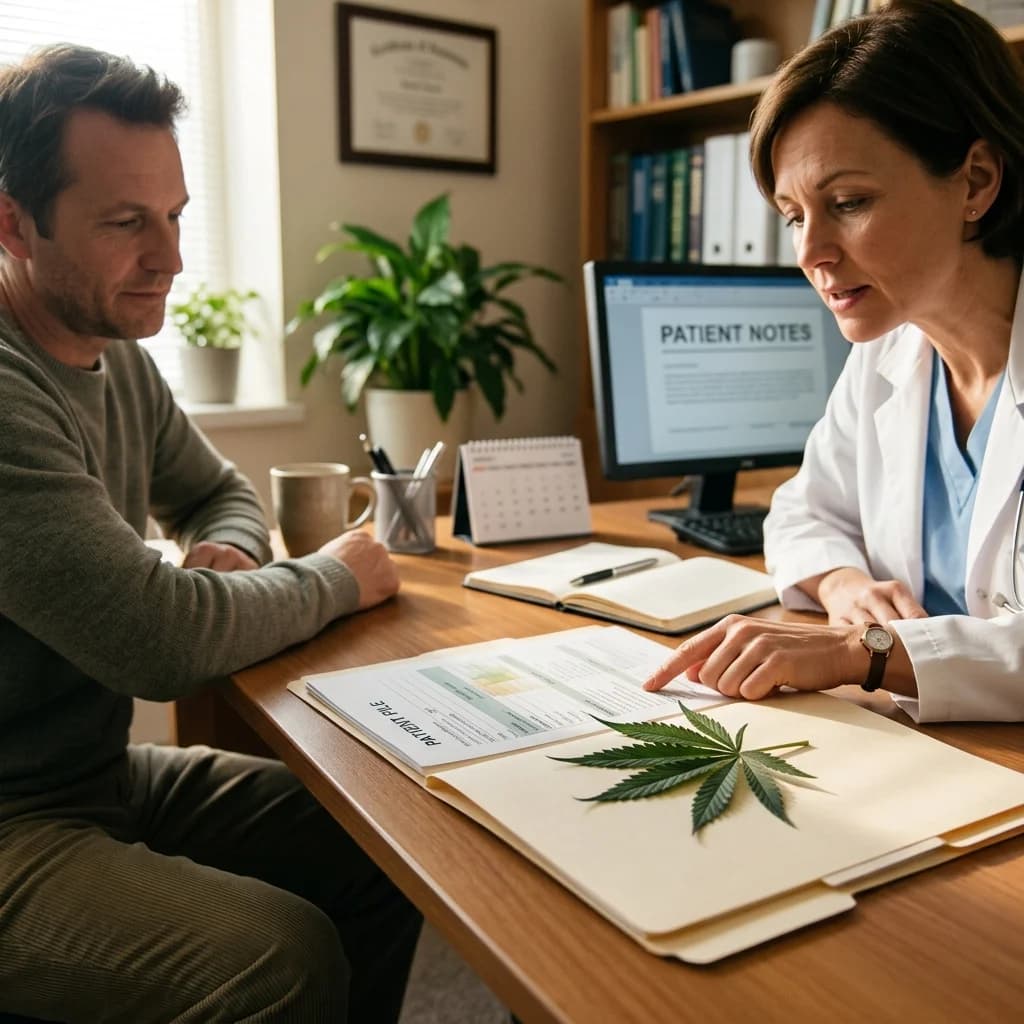
However, your NHS GP plays an essential role in your journey. To register with any legal private cannabis clinic, you will need to provide your Summary Care Record (SCR) or an official medical summary letter detailing your diagnosis history, current prescriptions, and past treatments.
You do not need formal permission or a referral letter from your GP to contact a private clinic. By law under the Data Protection Act and UK GDPR, you have the right to request a full copy of your medical history from your GP surgery free of charge.
Maintaining open, transparent communication with your GP is vital. Private cannabis clinics send routine clinical update letters to your registered NHS GP after every consultation to ensure continuity of care and prevent adverse drug-drug interactions.

Quick Questions

No. General Practitioners are legally prohibited from initiating CBPM prescriptions. Only GMC-registered specialist consultants (e.g. consultant neurologists, pain specialists, psychiatrists) can initiate treatment.
NICE guideline NG144 currently states there is insufficient high-grade randomised controlled trial (RCT) evidence proving long-term cost-effectiveness for chronic pain, despite substantial real-world patient data.
No. Accessing private medical cannabis does not impact your entitlement to NHS care, GP appointments, or ongoing NHS prescriptions. Your private specialist will keep your GP informed.
Initial consultations typically range from £40 to £150. Ongoing medication costs range from £100 to £300 per month depending on individual dosage, condition severity, and product selection.
An IFR is a formal application made by an NHS consultant to an Integrated Care Board requesting funding for a non-routine medication on the grounds of clinical exceptionality. Over 95% of cannabis IFRs are rejected.

About the Author

DM

Dave Mak

Dave founded The Budophile to create clear, honest cannabis education for UK beginners. With a background in health research and a network of specialist contributors, he ensures every guide is accurate, evidence-based, and practical. He also runs Baked & Rated for product reviews and The Green Prescription for medical cannabis access guidance.

Continue Learning
How to Get a Medical Cannabis Prescription

How to Get a Medical Cannabis Prescription

Read this guide next →
What Conditions Qualify for Medical Cannabis?

What Conditions Qualify for Medical Cannabis?

Read this guide next →

Is Medical Cannabis Safe?

Is Medical Cannabis Safe?

Read this guide next →

Is Cannabis Legal in the UK?

Is Cannabis Legal in the UK?

Read this guide next →
Medical Cannabis for Chronic Pain: UK Access

Medical Cannabis for Chronic Pain: UK Access

Read this guide next →
How to Talk to Your GP About Medical Cannabis

How to Talk to Your GP About Medical Cannabis

Read this guide next →

Featured App

Damlive

Your ultimate guide to Amsterdam's cannabis culture. Discover coffeeshops, read reviews, and explore live menus.

Explore Damlive

BUDOPHILE//KB

Cannabis education for beginners. Clear, honest, UK-legal information to help you make informed choices.

New Guides

Learn

  • Guides
  • Glossary
  • FAQ

Info

  • About
  • Contact
  • Privacy
  • RSS Feed

Our Network

  • DAM Live — Amsterdam Guide
  • The Green Prescription — UK Medical Cannabis
  • Baked &amp; Rated — Hardware Reviews
  • Strain Genetics Archive

© 2026 The Budophile. For educational purposes only.